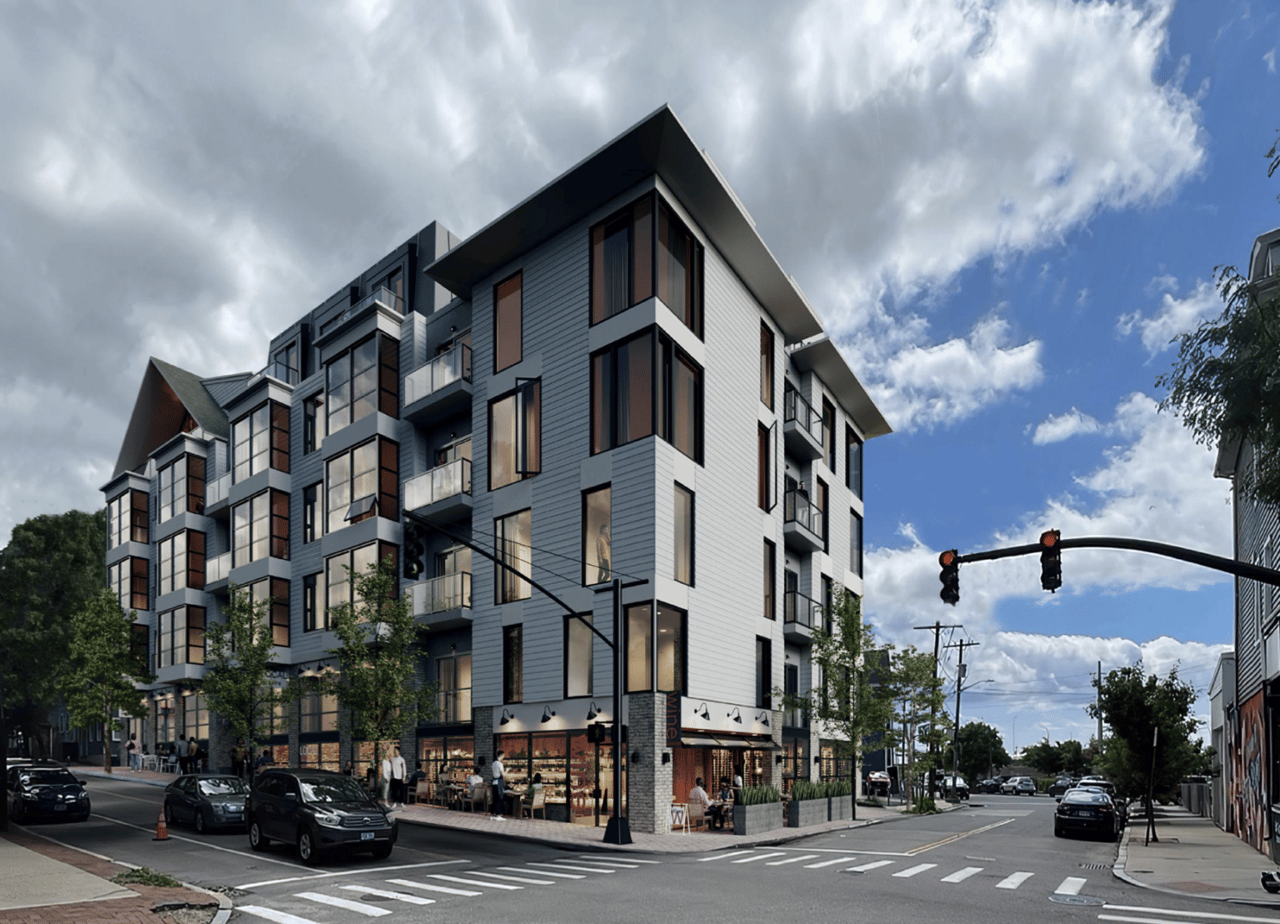
Photo courtesy of Providence Preservation Society
If you are shopping the east side of Providence and Fox Point keeps coming up as the neighborhood with the "protected" character, the porches, the walkability, the sense that nobody is about to drop a five-story building next to your 1870s cottage, it is worth understanding exactly what that protection covers. Because on Wickenden Street right now, the answer is: less than most buyers assume, and the mechanism that decides it runs through zoning arithmetic, not architecture review.
Here is the short version. A developer wanted to put a 75-unit apartment building on a lot at the corner of Wickenden and Brook Streets. According to the Providence Preservation Society, Providence's zoning code exempts any lot of 10,000 square feet or smaller from the city's parking requirements, on the theory that small parcels cannot fit meaningful parking anyway. The actual lot is 10,108 square feet. A zoning official ruled that it could still be treated as though it were under the 10,000-square-foot line, and because the change was small enough, no public notice was legally required. That single administrative call is why the building moving through Providence's approval process today has zero required parking, on a corridor where residents were already fighting over spots.
What "historic" actually covers here
Fox Point trades heavily on the word historic, and it earns some of that. Much of the neighborhood sits inside the College Hill Historic District, one of the largest National Register districts in Rhode Island. But National Register status is a designation. It documents significance.
According to PVDEye, the buildings that stood at 269 Wickenden before the current proposal were classified as "non-contributing" structures within that National Register district. That classification matters more than most buyers realize, because the proposal for 269 Wickenden did not need review by Providence's Historic District Commission. A National Register listing gives a building prestige.
The consequences of that gap showed up before this current fight. In 2021, a colonial-era house at 312 Wickenden Street, the building that had housed the restaurant Duck and Bunny, was demolished by its owner with almost no warning. Later that year, Ward 1 Councilman John Goncalves began pushing for a local historic district specifically for Fox Point.
The building that tested the gap
The 269 Wickenden project has been through nearly three years of hearings, and its proposal changed during that process.
According to the Brown Daily Herald, in August 2023, the Providence City Plan Commission approved a master plan for a five-story building on the site, one story taller than the neighborhood's C-2 zoning normally allows. Neighbors packed the meeting. Fox Point Neighborhood Association board member Vin Scorziello warned the project would "set a precedent" for larger buildings along the corridor, and Goncalves wrote to the commission stressing the importance of "keeping Wickenden Wickenden," according to the Brown Daily Herald.
The design kept changing through 2023 and 2024. The unit count grew from 62 to 75, while developer Dustin Dezube of Fox Point Capital LLC and architect Kevin Diamond reduced individual apartment sizes. Internal parking spaces dropped from 20 to 12, then to zero once the lot-size ruling came through. The building's legal frontage was switched from Wickenden Street to Brook Street, and its top story was pulled back so it would not be visible from the corner.
As reported by GoLocalProv, resident Roz Rustigian, testifying against the project, put the stakes in blunt terms:
"Once this building raises property values, everything else around it is going to fall. I don't want to be a Stepford Wife and live in every town USA."
Others made the opposite case. Daniel Morris, a renter in the neighborhood, argued that Providence is in a housing crisis and that new units within walking distance of jobs matter more than preserving a particular streetscape. Both positions were represented at every hearing. What actually moved the project forward was not the volume of opposition, it was the commission's reading of the zoning code.
The project cleared a major hurdle on February 18, 2026, when the City Plan Commission granted preliminary plan approval on a 4-1 vote, with Commissioner Cyd McKenna dissenting. Goncalves testified again at that meeting that the design's "deficiencies still look pretty glaring," specifically citing bike parking placed in the public right of way. Commissioner Dave Caldwell acknowledged the building was "not easy to love" but said Providence needed the housing badly enough, in the middle of winter, to let the process run its course.
The clock that hasn't started
While that building worked through the approval pipeline, Goncalves has spent three-plus years trying to build the other side of the story: a true local historic district for Fox Point.
That effort has moved slowly, because Rhode Island's local historic district law sets a high bar. According to the Fox Point Neighborhood Association, petitioners need signatures from roughly 150 of the neighborhood's approximately 200 remaining owner-occupied properties. At a July 2024 meeting where 75 to 100 residents turned out, most supportive, Goncalves reported having gathered 25 to 30 signatures. The math is not close. Until that threshold is met and the district is formally created, the proposed district is not in effect.
What this means if you are comparing East Side blocks
If you are weighing Fox Point against other Providence neighborhoods, or weighing one block of Fox Point against another, the useful question is not "is this historic." It is "which layer of protection actually applies here, and does it cover the corridor or just the interior."
A few distinctions worth carrying into a walk-through or a comparison of listings:
- Homes inside a recognized local historic district are commonly cited as carrying a 10 to 20 percent premium over similar homes outside one.
- At 269 Wickenden, new construction did not need Historic District Commission approval.
- Parking is not guaranteed by lot size the way most people assume.
- The Fox Point local historic district Goncalves is pursuing remains proposed, not in effect.
None of this means Fox Point is a bad bet. Walkability, waterfront proximity, and a genuinely distinct commercial strip are real advantages that do not depend on a historic designation to hold their value. It means the specific promise of "protected character" needs to be checked block by block rather than assumed neighborhood-wide, especially if the parcel you are considering sits directly on or near Wickenden itself.
Frequently asked questions
Is more large-scale construction likely on Wickenden Street? The 269 Wickenden approval process is one example. Whether more projects follow depends on site availability and market conditions.
Where does the Fox Point local historic district effort stand? As of the most recent public reporting, the petition drive led by Councilman Goncalves had gathered a fraction of the roughly 150 signatures needed from the neighborhood's owner-occupied properties, so the district has not yet been formally established.
If you are weighing Fox Point against other Providence neighborhoods and want a read on which blocks carry real protection versus which ones are one zoning ruling away from change, the Steven Miller Group can walk the specifics with you, parcel by parcel, before you make an offer.
This article is general information, not legal, tax or financial advice. Consult a qualified professional about your situation.